
Loading...
Loading...
Loading...
Products
Subscribe for our best offers, exclusives and new products
You can unsubscribe at anytime. See our privacy policy for more information on how we use your data.
Nexium contains a medicine called esomeprazole. This belongs to a group of medicines called ‘proton pump inhibitors'. They work by reducing the amount of acid that your stomach produces.
Nexium is used to treat the following conditions:
Adults
‘Gastroesophageal reflux disease' (GERD). This is where acid from the stomach escapes into the gullet (the tube which connects your throat to your stomach) causing pain, inflammation and heartburn.
Ulcers in the stomach or upper part of the gut (intestine) that are infected with bacteria called ‘Helicobacter pylori'. If you have this condition, your doctor may also prescribe antibiotics to treat the infection and allow the ulcer to heal.
Stomach ulcers caused by medicines called NSAIDs (Non-Steroidal Anti-Inflammatory Drugs). Nexium can also be used to stop stomach ulcers from forming if you are taking NSAIDs.
Too much acid in the stomach caused by a growth in the pancreas (Zollinger-Ellison syndrome).
Prolonged treatment after prevention of rebleeding of ulcers with intravenous Nexium.
Adolescents aged 12 years and above
‘Gastroesophageal reflux disease' (GERD). This is where acid from the stomach escapes into the gullet (the tube which connects your throat to your stomach) causing pain, inflammation and heartburn.
Ulcers in the stomach or upper part of the gut (intestine) that are infected with bacteria called ‘Helicobacter pylori'. If you have this condition, your doctor may also prescribe antibiotics to treat the infection and allow the ulcer to heal.
2. What you need to know before you take Nexium
Do not take Nexium:
If you are allergic to esomeprazole or any of the other ingredients of this medicine (listed in section 6).
If you are allergic to other proton pump inhibitor medicines (e.g. pantoprazole, lansoprazole, rabeprazole, omeprazole).
If you are taking a medicine containing nelfinavir (used to treat HIV infection).
Do not take Nexium if any of the above apply to you. If you are not sure, talk to your doctor or pharmacist before taking Nexium.
Warnings and precautions
Talk to your doctor or pharmacist before taking Nexium:
If you have severe liver problems.
If you have severe kidney problems.
If you have ever had a skin reaction after treatment with a medicine similar to Nexium that reduces stomach acid.
If you are due to have a specific blood test (Chromogranin A).
Nexium may hide the symptoms of other diseases. Therefore, if any of the following happen to you before you start taking Nexium or while you are taking it, talk to your doctor straight away:
You lose a lot of weight for no reason and have problems swallowing.
You get stomach pain or indigestion.
You begin to vomit food or blood.
You pass black stools (blood-stained faeces).
If you have been prescribed Nexium "on demand" you should contact your doctor if your symptoms continue or change in character.
Taking a proton pump inhibitor like Nexium, especially over a period of more than one year, may slightly increase your risk of fracture in the hip, wrist or spine. Tell your doctor if you have osteoporosis or if you are taking corticosteroids (which can increase the risk of osteoporosis).
If you get a rash on your skin, especially in areas exposed to the sun tell your doctor as soon as you can, as you may need to stop your treatment with Nexium. Remember to also mention any other ill-effects like pain in your joints.
Children under the age of 12 years
Information on dosing for children aged 1 to 11 years is provided in Nexium sachet product information (ask your doctor or pharmacist if you require further information).
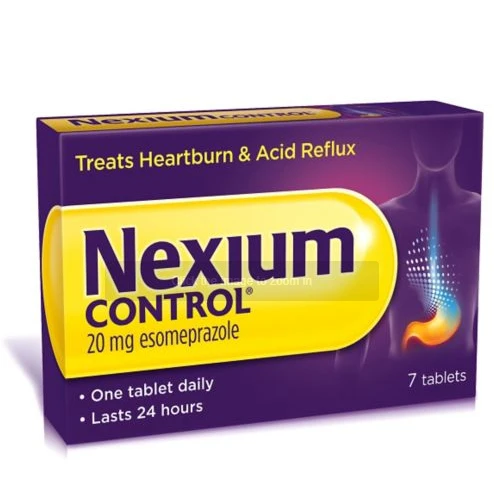
*Images are for illustrative purposes only
*Images are for illustrative purposes only

VETOQUINOL
£1.99
Item no: NEXIUM