Loading...
Loading...
Loading...
Subscribe for our best offers, exclusives and new products
You can unsubscribe at anytime. See our privacy policy for more information on how we use your data.
Uses
Treatment of infections caused by strains of microorganisms susceptible to marbofloxacin.
In dogs:
-skin and soft tissue infections (skinfold pyoderma, impetigo, folliculitis, furunculosis, cellulitis);
-urinary tract infections (UTI) associated or not with prostatitis or epididymitis;
-respiratory tract infections.
In cats:
-skin and soft tissue infections (wounds, abscesses, phlegmons);
-upper respiratory tract infections.
Dosage and administration
FOR ORAL ADMINISTRATION
The recommended dose rate is 2 mg/kg/day in single daily administration.
Where appropriate, in dogs only, the use of combinations of whole or half tablets of different strengths (5 mg, 20 mg or 80 mg) will allow accurate dosing.
Quiflor Dosage Chart

To ensure a correct dosage body weight should be determined as accurately as possible to avoid underdosing.
Duration of treatment:
Dogs:
-in skin and soft tissue infections, treatment duration is at least 5 days and depending on the course of the disease, it may be extended up to 40 days.
-in urinary tract infections, treatment duration is at least 10 days and depending on the course of the disease, it may be extended up to 28 days.
-in respiratory infections, treatment duration is at least 7 days and depending on the course of the disease, it may be extended up to 21 days.
Cats:
-for skin and soft tissue infections (wounds, abscesses, phlegmons) treatment duration is 3 to 5 days.
-for upper respiratory infections treatment duration is 5 days.
Use during pregnancy and lactation
Studies in laboratory animals (rat, rabbit) showed no embryotoxicity, teratogenicity and maternotoxicity with marbofloxacin at therapeutic doses. However no specific studies have been carried out in pregnant or lactating cats and dogs. Therefore, in these classes of animals, use only according to the benefit/risk assessment by the responsible veterinarian.
Adverse reactions
Mild side effects such as vomiting, softening of faeces, modification of thirst or transient increase in activity may occasionally occur. These signs cease spontaneously after treatment and do not necessitate cessation of treatment.
Contra-indications, warnings, etc
Do not use in dogs aged less than 12 months, or less than 18 months for exceptionally large breeds of dogs, such as Great Danes, Briard, Bernese, Bouvier and Mastiffs, with a longer growth period.
Do not use Quiflor 20mg or 80mg in cats. For the treatment of this species, a 5 mg tablet is available.
Do not use Quiflor 5mg Tablets in cats aged less than 16 weeks.
Do not use in animals with known hypersensitivity to marbofloxacin or other (fluoro)quinolones or to any of the excipients of the product.
Special precautions for use in animals
A low urinary pH could have an inhibitory effect on the activity of marbofloxacin. Pyoderma occurs mostly secondary to an underlying disease, thus, it is advisable to determine the underlying cause and to treat the animal accordingly.
High doses of some fluoroquinolones may have epileptogenic potential. Cautious use is recommended in dogs diagnosed as suffering from epilepsy. However, at the therapeutic recommended dosage, no severe side-effects are to be expected in dogs. In particular, no lesions of the articular joints were encountered in clinical studies at the recommended dose rate.
Official and local antimicrobial policies should be taken in to account when the veterinary medicinal product is used. Fluoroquinolones should be reserved for the treatment of clinical conditions which have responded poorly, or are expected to respond poorly to other classes of antimicrobials. Whenever possible, use of fluoroquinolones should be based on susceptibility testing. Use of the product deviating from the instructions given in the SPC may increase the prevalence of bacteria resistant to the (fluoro)quinolones and may decrease effectiveness of treatment with other quinolones due to the potential for cross-resistance.
Special precautions to be taken by the person administering the veterinary medicinal product to animals
People with known hypersensitivity to (fluoro)quinolones should avoid using this product.
In case of accidental ingestion seek medical attention and show product label and/or package leaflet to the doctor.
Wash hands after use.
Interactions
Fluoroquinolones are known to interact with orally administered cations (Aluminium, Calcium, Magnesium, Iron). Insuch cases, the bioavailability of marbofloxacin may be reduced. Concurrent administration of theophylline products may be followed by inhibited theophylline clearance.
Overdose:
Overdosage may cause acute signs in the form of neurological disorders, which should be treated symptomatically.
Environmental Safety
Any unused veterinary medicinal product or waste materials derived from such veterinary medicinal product should be disposed of in accordance with local requirements.
Pharmaceutical precautions
Store in the original package in order to protect from light. This veterinary medicinal product does not require any special temperature storage conditions.
Halved tablets should be stored below 25°C in the original blister and be used for the next administration.
Keep the blister in the outer carton.
Shelf-life of the veterinary medicinal product as packaged for sale: 2 years.
Shelf life of half-tablets: 5 days.
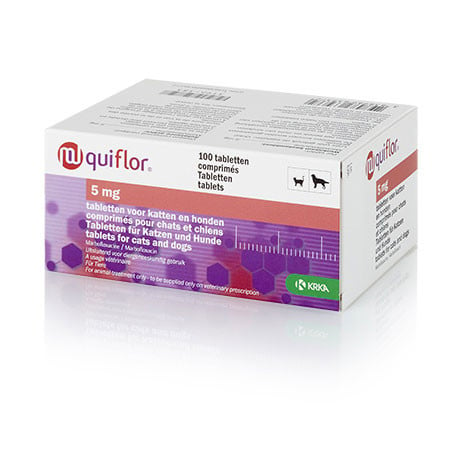
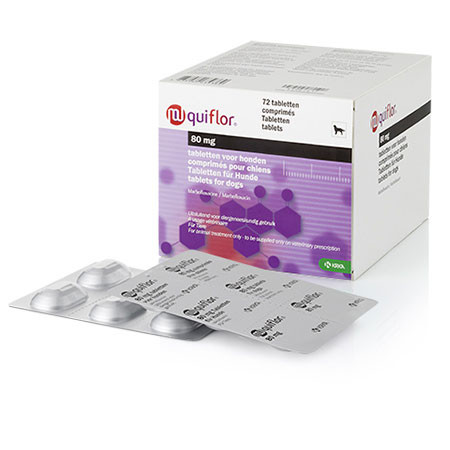
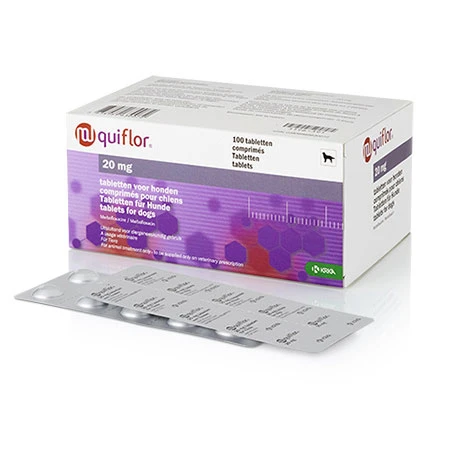
*Images are for illustrative purposes only
*Images are for illustrative purposes only
Item no: QUIFLORT